Introduction
When you encounter the term Tallyman Axis, you’re dealing with a powerful collections-and-recovery engine used by Axis Bank. This article offers a deep exploration of what Tallyman Axis truly means, why the bank adopted it, how the Tallyman Axis login process works, how collections are managed under the system, what it means for bank-collections processes and how business clients can benefit.
In Today’s articles, we also touch on the relationship between Tallyman Axis and Axis Bank’s broader collection services. Lets gets started!
What Is Tallyman Axis?
Tallyman Axis essentially refers to Axis Bank’s implementation of the Tallyman platform (by Experian) tailored to the bank’s collections and debt-management needs. Back in 2013, Axis Bank officially chose Tallyman software to manage customers in arrears, reduce collection cost and increase working capital by cutting write-offs.
The platform is capable of automating the lifecycle of delinquent customer accounts: from pre-delinquency monitoring and early outreach to full recovery processes. It segments portfolios into risk categories and triggers appropriate strategies.
In short, Tallyman Axis is the operational backbone behind how Axis Bank handles accounts that slip overdue, ensuring consistent workflow, auditability, analytics and efficiency.
Why Axis Bank Adopted Tallyman Axis
Axis Bank’s choice of Tallyman was motivated by three key drivers. First, the need to move away from manual spreadsheets and inefficient, inconsistent collections methods. Tallyman offered process automation and standardisation.
Second, the ambition to use data and segmentation – the bank wanted to treat different customer risk-profiles differently rather than a blanket approach. The press release pointed out that the software allows targeted and personalised collections rather than generic strategies. (experianplc.com) Third, the hosted version of Tallyman reduced dependence on internal IT resources and allowed faster deployment.
In a market where receivables and arrears can balloon quickly, the ability to scale and respond is essential.
Understanding the Tallyman Axis Login Process
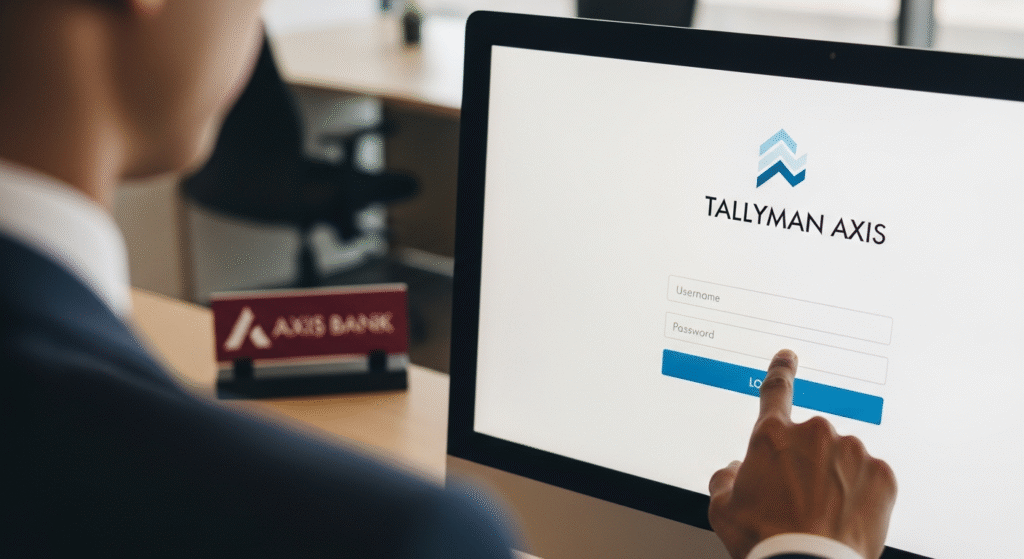
When you come across Tallyman Axis login or Tallyman Axis bank login, this refers to the authorised user access portal used by Axis Bank staff or vendor/agency partners rather than retail customers. The login portal listed as “Allocation – Login Site” (via the domain axisallocation.axisbank.co.in) shows fields for Username, Password and OTP.
A typical process: the authorised user receives credentials, accesses the portal via secure browser, enters username and password, then enters OTP (One-Time Password) as required by governance. After successful login, the user sees allocations, tasks, customer account status, actions to be taken and outcome logging.
The login environment is built for internal workflow and collections operations, not general banking transactions.
If you face login issues, ensure you’re using the correct official domain, use supported browsers, clear cache/cookies and verify your credentials with the bank’s collections admin.
How Tallyman Axis Works in Collections & Bank Collection Services
Tallyman Axis is deeply integrated into Axis Bank’s collections environment. The bank also offers a set of Collection Solutions under its Cash Management Services (CMS) including cash/cheque collection, Easy Pay online & branch, NACH mandate collection, virtual accounts etc.
Here’s how it typically flows: A customer-account begins to show signs of delinquency (missed payment, overdue). The Tallyman system flags the account, segments it by risk category, assigns a case to the relevant collector or agency, tracks contact attempts/outcomes, escalates when thresholds are met, and logs the results in dashboards and MIS for the bank.
Because the platform feeds into Axis Bank’s collection solutions and payment recon rails, payments from Easy Pay, NACH, virtual accounts etc become visible in “bank collection” workflows under the Tallyman Axis purview.
In other words, Tallyman Axis has two intertwined roles: firstly, the strategic orchestration of collection workflows; secondly, the integration with Axis Bank’s collection mechanisms (bank collection) so that payment realisation is faster, data is accurate, and transparency is maintained.
Benefits of Using Tallyman Axis for Axis Bank and Business Clients
For Axis Bank the benefits fall into operational efficiency, improved recovery, better data analytics and cost reduction. By automating allocation and tracking, the bank can reduce manual effort, reduce the cost-to-collect and enhance underwriting/credit control by tying back to performance data. The initial press release emphasises this transformation.
For business clients or distributors working with Axis Bank, the existence of a robust backend like Tallyman Axis means faster visibility of receivables, clearer status of overdue accounts, more consistent communication and potentially fewer surprises. Moreover, when the bank’s collection solutions and Tallyman workflows are aligned, reconciliation improves, suspense accounts reduce and cash-flow becomes more predictable.
In addition, segmentation and analytics allow the bank (and indirectly its business clients) to understand which portfolios or customer types are risky, enabling proactive mitigation rather than reactive chasing of bad debt.
Practical Considerations & Best Practice Alignment
While the platform is powerful, organisations must align their internal processes to benefit fully. A common challenge is ensuring that internal ERP or finance systems map to the bank’s workflow and that data flows seamlessly. Another consideration is training: users (internal staff, vendor agencies) must understand the case-allocation logic, outcome-recording and escalation rules.
The login process must be secure and compliant since sensitive financial data is handled. For business clients, understanding how their receivables will flow into the bank’s collection ecosystem (via CMS + Tallyman) allows better audit, tracking and forecasting.
It’s also crucial to monitor metrics that the Tallyman system emphasises: days past due (DPD), promise-to-pay (PTP) conversion, roll-rate movement, case-closure rates, and cost-to-collect. Without tracking these, the full benefit of using Tallyman Axis may not be realised.
Challenges & What to Watch For
Even with a high-grade system such as Tallyman Axis, there are risks. If the login portal is mis-managed (weak credentials, bad browser compatibility, ignored OTP), security and accessibility problems arise. If internal process change is not managed (shifting from spreadsheet/manual to automated workflows), the transition suffers.
If business clients do not understand how their own receivables map into the bank’s “bank collection” solutions, reconciliation delays may persist. Moreover, deployment of Tallyman doesn’t automatically solve all collection issues underlying credit risk, customer behaviour, macro-economic factors still matter.
The Future of Tallyman Axis
As digital banking evolves, Tallyman Axis is likely to expand its capabilities. Expect tighter integration with machine-learning models for early delinquency predictions, mobile-first collector apps for field action, real-time dashboards accessible by business clients, and deeper linkage with digital payment rails (for example UPI-mandate, open-banking, instant reconciliation).
Axis Bank’s broader CMS framework already supports real-time status, virtual accounts and online integration. The combination of Tallyman orchestration plus these rails means the collections ecosystem becomes faster, smarter and more data-driven.
FAQs
Q1: Who can log in via Tallyman Axis bank login?
Only authorised users of Axis Bank’s collections operations, including internal staff and approved partner agencies/vendors, can access the Tallyman Axis portal. It is not meant for general retail banking customers.
Q2: The term “tallyman axis bank collection” – what does it refer to?
This term refers to the bank’s collections workflow that uses Tallyman Axis as the backbone for managing overdue accounts, tracking payment realisation and logging outcomes, integrated with Axis Bank’s payment collection solutions.
Q3: How does Tallyman Axis collections differ from standard collections?
Unlike manual or spreadsheet-based collections, Tallyman Axis uses segmentation, workflow automation, analytics, case allocation, escalation rules and integration with bank payment rails. This results in faster, more consistent recovery and better data governance.
Q4: If I am a business client of Axis Bank, why should I care about Tallyman Axis?
Because Tallyman Axis affects how your receivables are managed if they slip into overdue status under Axis Bank’s collection mechanisms. A strong backend means faster treatment, clearer MIS, and potentially better alignment of cash flow.
Q5: Is the portal at “axisallocation.axisbank.co.in” the official Tallyman Axis login?
Yes, one of the official allocation/login portals (for authorised users) is hosted at that domain. Users must have proper credentials and OTP authentication to access the system. (axisallocation.axisbank.co.in)
Conclusion
Tallyman Axis is more than just a name it is a strategic and operational platform that underpins how Axis Bank handles collections, monitors risk and integrates payments. For internal stakeholders, authorised users and business-clients alike, understanding this system brings clarity to what happens behind the scenes when a receivable becomes overdue, how the bank acts and how outcomes are tracked.
If your business works with Axis Bank or you’re part of credit/collections operations in a banking context, embracing the logic, process and metrics of Tallyman Axis will place you ahead.
As the banking world moves ever more digital, systems like Tallyman Axis will continue to evolve and those prepared will find themselves aligned for efficiency, control and transparency.
Related Stories: Traceloans.com Review: What You Need to Know Before Applying for a Loan