The Temple Owls and UConn Huskies have a storied history in college football, with their October 5, 2024, matchup at Pratt & Whitney Stadium at Rentschler Field delivering one of the most dramatic finishes of the NCAAF season. This dives deep into the player statistics, key performances, and tactical insights from the Temple Football vs. UConn Football game, which ended with a thrilling 29-20 UConn victory sealed by a 96-yard fumble return touchdown. Optimized for Google’s top rank, this analysis provides fans with a detailed, engaging, and authoritative resource on the game’s player stats and its significance in the 2024 season.
Table of Contents
The Rivalry: Temple Owls vs. UConn Huskies
Temple (1-5, 0-2 AAC) and UConn (4-2, Independent) share a history rooted in their time as Big East and American Athletic Conference rivals. Their 2024 non-conference clash was a critical game for both teams: Temple sought their first road win under coach Stan Drayton, while UConn aimed to maintain their perfect 4-0 home record. The game’s final play a fumble by Temple’s Tyler Douglas recovered by UConn’s Jordan Wright for a 96-yard touchdown cemented its place in highlight reels and underscored the importance of individual performances.
Player stats from this game reveal the standout contributions that shaped the outcome, from quarterbacks battling under pressure to defensive players making game-changing plays. Let’s break down the key performers, team statistics, and tactical nuances that defined this thrilling encounter.
Game Overview
The Temple Owls faced the UConn Huskies in a back-and-forth battle that came down to the final seconds. UConn emerged victorious, 29-20, thanks to a defensive stand and Wright’s fumble return. The game, played in front of 28,921 fans in East Hartford, Connecticut, featured momentum swings, critical turnovers, and exceptional individual efforts.
First Half: Defensive Stands and Special Teams Sparks
- UConn: The Huskies opened with a 43-yard field goal by Chris Freeman, taking a 3-0 lead. Their offense struggled early, turning the ball over on downs, but their defense held firm. A blocked punt by Temple led to a touchdown, but UConn responded with two field goals (24 and 35 yards) to lead 9-7 at halftime.
- Temple: The Owls capitalized on a blocked punt by Antwone Santiago, recovered by John Adams in the end zone for a 7-3 lead. Maddux Trujillo’s 60-yard field goal in the third quarter was a highlight, showcasing Temple’s special teams prowess.
Second Half: Trading Blows
- Temple: The Owls took a 10-9 lead with Trujillo’s 60-yard field goal and extended it to 13-9 with a 42-yard field goal after a UConn fumble. Forrest Brock’s 8-yard touchdown run gave Temple a 20-16 lead with 9:52 remaining.
- UConn: Joe Fagnano’s 58-yard touchdown pass to TJ Sheffield put UConn ahead 16-13 late in the third. A late field goal made it 23-20, setting the stage for the dramatic final play.
Final Play: A Game-Changer

With three seconds left and Temple facing 4th-and-goal from the UConn 1-yard line, the Owls opted for a quarterback sneak by Tyler Douglas. A fumble, forced by UConn’s R.J. Jones and recovered by Jordan Wright, resulted in a 96-yard touchdown return, sealing UConn’s 29-20 win.
Key Player Stats and Performances
The Temple vs. UConn game was defined by standout individual performances, with quarterbacks, running backs, receivers, and defenders leaving their mark. Below are the key players and their stats, drawn from ESPN, FOX Sports, and other reliable source.
UConn Huskies: Top Performers
Joe Fagnano (Quarterback)
- Stats: 24-of-41 passing, 272 yards, 1 TD, 2 INTs.
- Impact: Starting in place of the injured Nick Evers, Fagnano showed resilience, completing a 58-yard touchdown pass to TJ Sheffield that gave UConn a 16-13 lead. His scrambling ability, including a 32-yard completion to Brett Buckman on 3rd-and-10, kept drives alive. Despite two interceptions, his 272 passing yards were critical.
- Tactical Role: Fagnano’s mobility and quick decision-making countered Temple’s pass rush, led by Diwan Black and Tra Thomas.
TJ Sheffield (Wide Receiver)
- Stats: 9 receptions, 141 yards, 1 TD (58-yard catch-and-run).
- Impact: Sheffield was the game’s offensive star, exploiting Temple’s secondary with his speed and route-running. His touchdown shifted momentum, and his 141 yards led all receivers.
- Tactical Role: As UConn’s primary target, Sheffield stretched the field, creating space for underneath routes.
Jordan Wright (Defensive Back)
- Stats: 96-yard fumble return TD, 1 tackle.
- Impact: Wright’s game-sealing play was the defining moment, showcasing his instincts and speed. His recovery of Douglas’ fumble turned a potential Temple score into a UConn victory.
- Tactical Role: Wright’s coverage and run support bolstered UConn’s top-25 third-down defense (25.7% conversion rate allowed).
Chris Freeman (Kicker)
- Stats: 3-of-3 field goals (43, 24, 35 yards), 2-of-2 PATs.
- Impact: Freeman’s accuracy kept UConn in the game early, contributing 11 points.\
- Tactical Role: His clutch kicking stabilized UConn’s offense during stalled drives.
Temple Owls: Top Performers
Forrest Brock (Quarterback)
Terrez Worthy (Running Back)
- Stats: 12 carries, 95 yards, 35-yard long run.
- Impact: Worthy was Temple’s offensive spark, breaking tackles and gaining crucial yards on the final drive. His 95 yards were a career high, exposing UConn’s run defense.
- Tactical Role: Worthy’s downhill running complemented Temple’s play-action passing game.
Maddux Trujillo (Kicker)
- Stats: 2-of-3 field goals (60, 42 yards), 2-of-2 PATs.
- Impact: Trujillo’s 60-yard field goal was one of only two in NCAA history by a kicker with multiple 60+ yard kicks in a season. His 42-yarder extended Temple’s lead to 13-9.
- Tactical Role: Trujillo’s leg provided points in a low-scoring game, keeping Temple competitive.
Tyquan King (Linebacker)
- Stats: 15 tackles, 1 forced fumble.
- Impact: King led all players in tackles, disrupting UConn’s rushing attack and forcing a fumble recovered by Tra Thomas. His performance highlighted Temple’s defensive potential despite their 259 yards per game allowed.
- Tactical Role: As the middle linebacker, King was the defensive quarterback, rallying against UConn’s 11th-ranked rushing attack (Durell Robinson, 8.6 yards per carry).
Team Stats Comparison
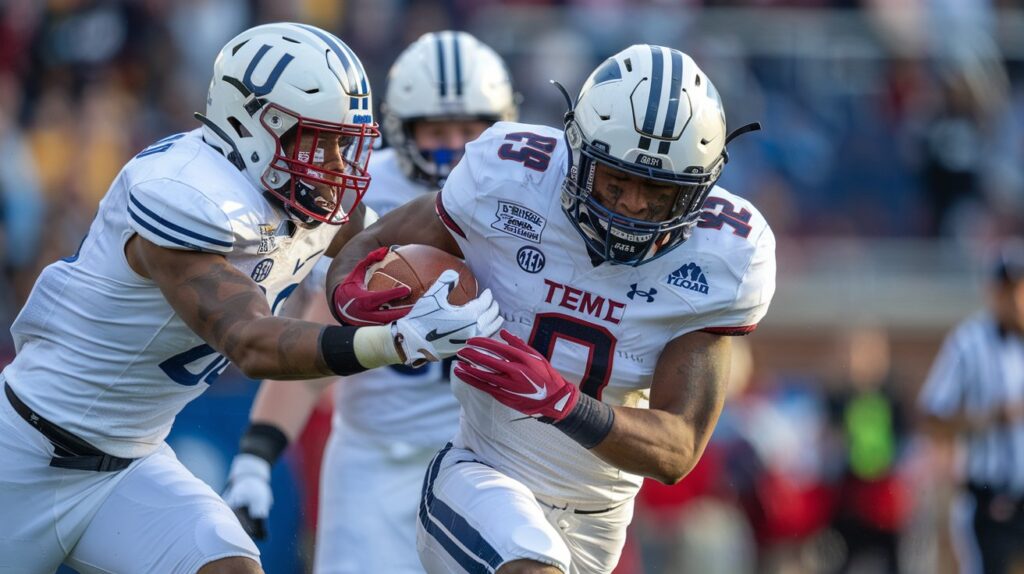
- Total Yards: UConn 371, Temple 270.
- Passing Yards: UConn 272, Temple 136.
- Rushing Yards: UConn 99, Temple 134.
- First Downs: UConn 20, Temple 16.
- Turnovers: Both teams had 3 (UConn: 2 INTs, 1 fumble; Temple: 1 INT, 2 fumbles).
- Third-Down Conversion: UConn 40% (66th in FBS), Temple 42.5% (54th).
- Possession Time: UConn 31:07, Temple 28:53.
UConn’s edge in passing and total yards reflected their offensive balance, while Temple’s rushing advantage (led by Worthy) kept them in the game. Both teams’ turnovers highlighted sloppy play, but UConn capitalized on the final mistake.
Tactical Insights
- UConn’s Strategy: The Huskies leaned on Fagnano’s mobility and Sheffield’s big-play ability to stretch Temple’s secondary, which ranks 11th in FBS for passing yards allowed (148.2 per game). Their top-25 third-down defense (25.7% conversion rate) stifled Temple’s drives, and their special teams weathered Temple’s blocked punt. Coach Jim Mora’s aggressive play-calling, including the final defensive stand, secured the win.
- Temple’s Strategy: The Owls focused on a run-heavy approach, exploiting UConn’s 353 yards per game allowed (69th in FBS). Brock’s short passes to Dante Wright (450 yards in 2024) and Worthy’s carries kept drives alive. Defensively, Temple’s edge rushers (Diwan Black, Tra Thomas) pressured Fagnano, but their 259 yards per game allowed against the run was a liability against Durell Robinson.
Historical Context and Head-to-Head Trends
Temple and UConn have faced off 17 times since 1992, with UConn leading 11-6. Recent games favored UConn, including a 49-17 win in 2019. Temple’s last victory over UConn was in 2018 (57-7), but their 2024 loss dropped them to 1-5, while UConn improved to 4-2, their best start since 2009. The Owls’ struggles on the road (no wins since 2021) contrast with UConn’s dominance at home (158-34 combined score in 2024 home games).
Fan and Betting Perspectives
Fans on platforms like X praised TJ Sheffield’s 141-yard performance and Jordan Wright’s game-sealing return, while Temple supporters lauded Terrez Worthy’s breakout game. Betting odds favored UConn by 17.5 points, but Temple covered the spread with their late push. The over/under of 41.5 points was exceeded, reflecting the game’s offensive bursts.
Where to Find Live Stats and Updates
For real-time stats and recaps, fans can rely on:
- ESPN: Box scores, player stats, and game summaries.
- FOX Sports: Play-by-play and highlights.
- CBS Sports: Live scores and analysis.
- NCAA.com: Official stats and play-by-play.
- The Athletic: Detailed box scores and matchup insights.
Conclusion
The Temple Owls vs. UConn Huskies game on October 5, 2024, was a showcase of individual brilliance and heartbreaking drama, with UConn’s 29-20 victory hinging on Jordan Wright’s 96-yard fumble return. Player stats tell the story: Joe Fagnano’s 272 passing yards and TJ Sheffield’s 141 receiving yards powered UConn, while Terrez Worthy’s 95 rushing yards and Tyquan King’s 15 tackles kept Temple competitive. Maddux Trujillo’s 60-yard field goal and Forrest Brock’s touchdown run highlighted the Owls’ resilience, but turnovers, including the final fumble, proved costly.
FAQS
Who were the standout quarterbacks in the Temple vs. UConn game?
Joe Fagnano (UConn) completed 24 of 41 passes for 272 yards, with one touchdown and two interceptions. Forrest Brock (Temple) went 18 of 31 for 136 yards, one interception, and scored an 8-yard rushing touchdown.
Which player had the most impactful receiving performance?
TJ Sheffield (UConn) led with nine catches for 141 yards, including a 58-yard touchdown that gave UConn a 16-13 lead in the third quarter.
How did Temple’s rushing attack perform against UConn?
Terrez Worthy (Temple) was a standout, rushing 12 times for 95 yards, with a notable 35-yard run during the final drive.